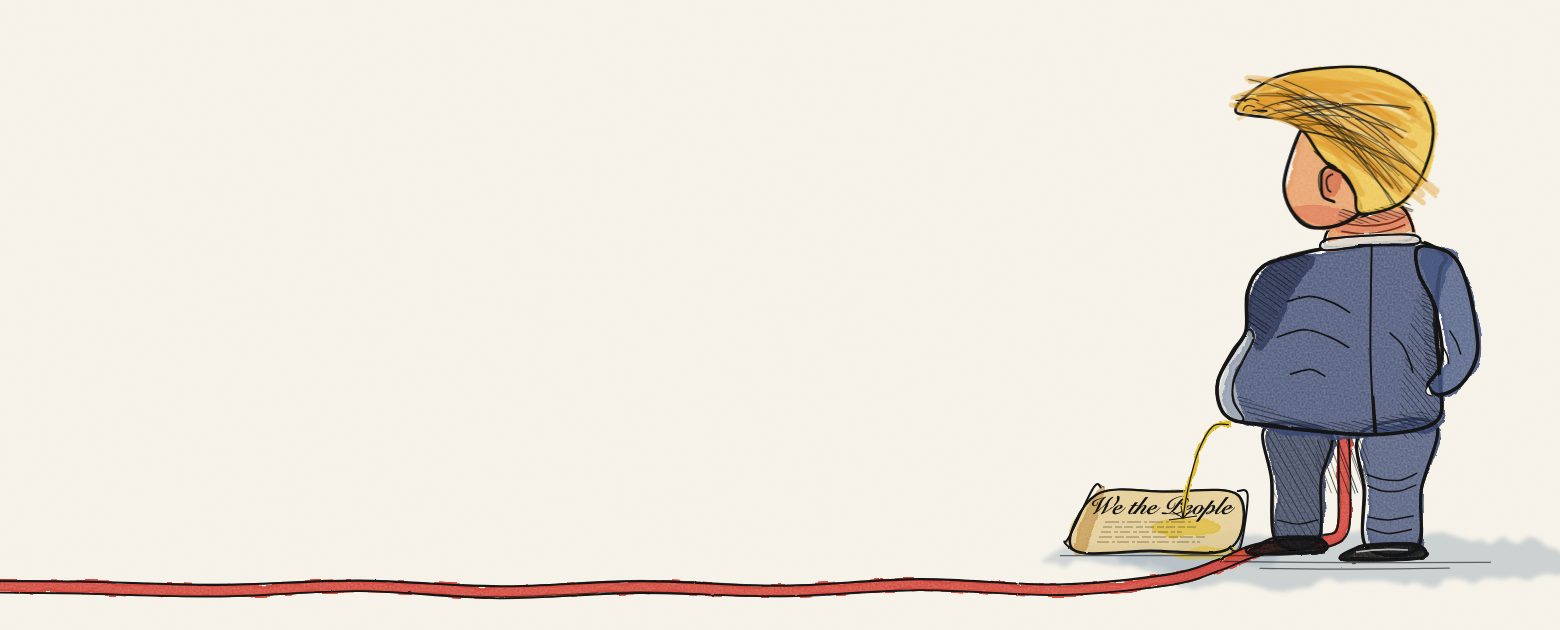
The Grotesque-to-Authoritarian Transition
A hypothesis of strategic democratic destabilisation
The Grotesque-to-Authoritarian Transition
Abstract
This article proposes that the deliberate promotion and amplification of destructive, incompetent or openly grotesque political leadership may serve a purpose beyond winning elections or advancing an ideology. It may help undermine confidence in democracy itself.
The proposed strategy has two stages. First, destructive political leadership is amplified until even informed observers begin to question whether the electorate is capable of governing itself. Second, a contrasting figure emerges: the Good King. Calm, competent and apparently reasonable, this leader offers an attractive alternative to political chaos while concealing an underlying authoritarian agenda.
The intended result is a shift in public attitudes: from rejecting an openly destructive leader to accepting concentrated power in the hands of someone who appears capable of using it responsibly.
This is a hypothesis, not an established explanation of current political events. The article sets out how the proposed process might work, what evidence would support it, and what findings would disprove it.
1. The question
Can a political influence operation deliberately undermine confidence in democratic government by amplifying destructive political leadership, then use the resulting disillusionment to make authoritarian government more acceptable?
The central idea is that one generation of apparently incompetent or destructive leaders might help prepare the ground for a very different kind of authoritarianism.
The intended audience is not necessarily the supporters of those leaders. It may instead be the people who oppose them, understand the damage they cause, and gradually lose faith in the ability of democratic institutions and voters to prevent it happening again.
The ultimate objective would not necessarily be a traditional personality cult. It would be something potentially more durable: a public acceptance that concentrated executive power is preferable to the uncertainty and apparent dysfunction of democracy, provided that the person exercising that power appears competent.
2. The central hypothesis
H1 — The Strategic Democratic Despair Hypothesis
A political actor or coordinated network can increase support for authoritarian government by amplifying destructive political leadership, weakening democratic commitment among informed observers, and subsequently promoting an apparently contrasting leader whose competence and restraint make concentrated power more acceptable.
The hypothesis has four parts:
- Destabilisation: Destructive political behaviour is deliberately amplified, reducing confidence in democratic government.
- Loss of confidence: Informed observers move from disliking particular leaders to questioning whether voters are capable of governing themselves.
- The alternative: A seemingly reasonable, competent and restrained leader becomes attractive by comparison.
- Acceptance of authoritarianism: The public becomes more willing to weaken the institutions that limit executive power.
All four parts need to be supported for the complete hypothesis to hold. Evidence of authoritarianism alone does not establish a coordinated strategy to produce it.
3. How the process might work
Stage A: The grotesque phase
Political leaders display conspicuous cruelty, incompetence, corruption, instability or disregard for democratic institutions.
These characteristics do not need to be manufactured. The leaders may genuinely behave this way. The proposed strategy is about selecting, amplifying, protecting or exploiting that behaviour.
This serves two possible purposes:
- It attracts attention, mobilises supporters and disrupts existing political arrangements.
- It gives opponents repeated examples of apparently irrational electoral behaviour, gradually undermining their confidence in democratic government.
Each new controversy or transgression may also shift the boundaries of what the public considers acceptable political behaviour.
Prediction: Where deliberate amplification takes place, destructive political behaviour will receive more prominence and become more normalised than would be expected from public preferences, ordinary political incentives and independent media coverage alone.
Stage B: The loss of democratic confidence
The intended effect on informed observers is not necessarily to make them believe something untrue.
Instead, it changes how they interpret what they see.
The progression might look like this:
- A political leader behaves destructively.
- Voters continue to support that leader.
- Opponents conclude that voters cannot be persuaded by facts or ordinary political argument.
- Repeated electoral outcomes undermine confidence in democracy's ability to correct its own mistakes.
- Restricting the power of voters or weakening democratic safeguards begins to seem reasonable.
The critical distinction is between being unhappy with a particular election result and losing faith in the principle of democratic self-government.
Someone can accurately recognise political misconduct, oppose it, and still conclude that the electorate itself cannot be trusted.
That is the change this hypothesis seeks to explain.
Prediction: Repeated exposure to apparently destructive electoral outcomes will reduce democratic commitment among observers who interpret those outcomes as evidence that voters are incapable of governing themselves. This effect should remain measurable after accounting for existing political beliefs, party loyalty and general dissatisfaction.
Stage C: The Good King
A contrasting political figure emerges or is promoted.
The Good King is a public image, not a claim about the person's actual character. The leader may be just as authoritarian in their objectives as the figure they replace, but presents those objectives very differently.
The image is built around:
- Calmness and self-control.
- Competence and decisiveness.
- Restraint compared with previous leadership.
- A lack of obvious personal vanity or vulgar displays of power.
- An ability to appear above ordinary political disputes.
Importantly, the Good King does not need to demand personal devotion or present themselves as uniquely brilliant. Their appeal comes from appearing to represent competent government itself.
The contrast is between two presentations of authority: one grotesque and chaotic, the other reassuring and controlled.
The hypothesis predicts that people who have lost faith in democratic government may accept concentrated power more readily when it is offered by the second figure, even if the underlying political objectives are similar.
Prediction: A restrained and apparently competent authoritarian leader will attract greater support for concentrated executive power than an otherwise equivalent leader who presents themselves as aggressive, erratic or openly self-interested.
Stage D: Making authoritarian government acceptable
The final step is to turn the leader's apparent competence into an argument against democratic safeguards.
The reasoning might develop as follows:
- This leader is competent.
- Competent government requires decisive action.
- Democratic institutions prevent decisive action.
- Exceptional circumstances justify bypassing those institutions.
- Effective government requires fewer restrictions on executive power.
- Concentrated power is therefore a better way to govern.
The important change is from supporting a particular leader to accepting a different model of government.
The Good King does not necessarily need a conventional personality cult. Public loyalty can instead become attached to the idea of competent, unconstrained government.
The leader becomes a means of normalising an arrangement that can outlast them.
Prediction: Support for weakening democratic safeguards will increase when those changes are presented as necessary to preserve competent government, particularly among people who have already lost confidence in democracy.
4. Testable predictions
The hypothesis produces several predictions that can be examined independently.
| Hypothesis | What would be measured | Expected result |
|---|---|---|
| H1a: Amplification | Exposure to coordinated promotion of destructive political behaviour | People perceive that behaviour as more common and acceptable. |
| H1b: Democratic despair | Exposure to repeated destructive electoral outcomes | Democratic commitment declines among those who see voters as incapable of self-government. |
| H1c: The Good King | Presentation of a calm, competent authoritarian alternative | Greater acceptance of concentrated power than when the same proposal comes from an openly aggressive leader. |
| H1d: Weakening safeguards | Arguments that democratic checks prevent effective government | Greater support for removing those checks. |
| H1e: The complete sequence | Exposure to the proposed sequence of events | Increased authoritarian preference, partly explained by declining democratic commitment. |
| H1f: Coordination | Evidence linking the amplification campaign to the promotion of the alternative leader | Greater support for the claim that the process is deliberate rather than coincidental. |
The first five predictions concern how people respond to political events and messaging. The sixth concerns whether anyone deliberately organised those events into a single strategy.
That distinction matters. Demonstrating that the process works does not prove that anyone designed it.
5. Defining what needs to be measured
For the hypothesis to be tested properly, its main terms need clear definitions.
5.1 Destructive political leadership
This should be measured using identifiable behaviour, including:
- Encouragement or endorsement of political violence.
- Documented corruption or personal enrichment.
- Attacks on independent institutions.
- Repeated demonstrably false public claims.
- Disregard for legal and constitutional procedures.
- Consistent failures of competence or restraint.
Disagreement with someone's policies or political beliefs must not, by itself, count as evidence.
5.2 Informed observers
The study needs to identify people with measurable political knowledge, awareness of current affairs and an ability to assess political claims.
Education alone is not a reliable measure. Political knowledge, engagement, institutional trust and ideology need to be considered separately.
5.3 Democratic commitment
This means support for:
- Equal political participation.
- Free and competitive elections.
- Accepting legitimate electoral defeat.
- Independent courts and legislative oversight.
- Freedom of political opposition and expression.
- Peaceful transfers of power.
- The ability to remove a leader, even one considered competent.
Supporting effective government is not the same as rejecting democracy. The important question is whether people remain willing to defend the safeguards that limit political power.
5.4 The Good King
This is a public presentation built around competence, restraint, order and practical problem-solving.
These are perceived qualities, not assumptions about the leader's actual abilities or intentions.
Research must distinguish the leader's public image from their real behaviour and proposed changes to government.
5.5 Authoritarian consolidation
This means reducing the public's ability to challenge, constrain or remove those in power.
It can include:
- Weakening judicial independence.
- Reducing legislative oversight.
- Restricting political opposition.
- Making elections less competitive.
- Creating barriers to removing leaders from office.
Strong government or administrative efficiency alone does not qualify.
5.6 Coordinated influence
This requires evidence of organised activity connecting people, messages, distribution networks or political objectives.
Similar messaging, synchronised statements or automated accounts may justify further investigation, but do not prove that a central organisation directed them or that they share a common objective.
6. How to test the hypothesis
No single study can establish the complete argument. A combination of research methods is needed.
Study A: Follow people over time
Recruit politically engaged participants and measure their democratic commitment, institutional trust, political beliefs and attitudes towards authoritarian government at regular intervals.
Compare changes in those attitudes with their exposure to destructive political behaviour and political messaging.
The key questions are:
- Does exposure reduce confidence in democratic government?
- Is that effect linked to a growing belief that voters cannot govern themselves?
- Does declining democratic confidence precede greater support for concentrated executive power?
Researchers should account for existing political beliefs, party loyalty, economic insecurity, media consumption and trust in institutions.
Limitation: People choose what they watch and read. A relationship between media exposure and political attitudes does not, by itself, prove that one caused the other.
Study B: Test the Good King effect
Conduct controlled surveys in which participants are shown different versions of a hypothetical political leader.
Vary four things independently:
- Whether the preceding political environment is described as stable or dysfunctional.
- Whether the new leader appears calm and competent or aggressive and self-interested.
- Whether the leader proposes retaining or weakening democratic safeguards.
- Whether weakening those safeguards is justified as necessary for effective government.
Measure support for the leader, their proposals, democratic participation and the public's right to remove them.
The main question is whether the reassuring presentation makes people more willing to accept weakened democratic safeguards, particularly when they have been led to consider democracy dysfunctional.
Limitation: This can test the psychological mechanism. It cannot establish that a real-world political operation exists or that anyone intended to produce the same effect.
Study C: Compare historical examples
Examine historical cases where destructive leadership was followed by a more reassuring political figure, and compare them with cases where this did not happen.
For each case, establish:
- What happened during the period of political destabilisation.
- How the subsequent leader was presented.
- Whether public attitudes towards democracy changed.
- What institutional changes followed.
- Whether there is evidence connecting the people and organisations involved.
Relevant evidence could include internal documents, financial relationships, private communications, operational instructions and independently verified intelligence.
Cases where democratic institutions recovered, or where a reassuring successor maintained democratic safeguards, are equally important.
Limitation: A sequence of events does not establish a common plan. Researchers must consider other explanations and establish whether the events were connected.
Study D: Examine political messaging networks
Map how political messages spread and identify the people and organisations involved.
Look for evidence that the same actors deliberately amplify destructive political behaviour and subsequently promote the contrasting leadership model.
Examine:
- Timing and patterns of message distribution.
- Shared infrastructure and distribution networks.
- Financial and organisational connections.
- Evidence of common planning.
- Changes in public attitudes following exposure.
Compare these findings with ordinary partisan activity, commercial